30-day single entry
€50A short-validity option for one entry.
Philippines passport guide
This page is written around a Philippines passport and the decisions that affect a real Benin trip: exemption status, the travel document, first entry date and whether the route needs re-entry.
Nationality check
Benin's official eVisa FAQ says foreign nationals can submit an eVisa application online and separately gives African nationals a general 90-day visa-free rule. A Philippines passport comes from Southeast Asia, so do not assume that African-national rule covers this trip.
Before purchasing an eVisa, confirm whether your exact passport has any separate exemption. If a visa is required, use the published eVisa choices as the starting point rather than relying on a generic travel-site label.
Imagine a Philippines traveller taking a short leisure visit with one arrival. The visa decision should follow that route. If there is only one arrival, repeated-entry permission may add no value; if Benin appears twice in the itinerary, the entry question changes immediately.
For this route, the paperwork is less complicated when the travel plan is already settled. The passport, first entry date and number of intended entries should all be decided before the online form is opened.
Travel document
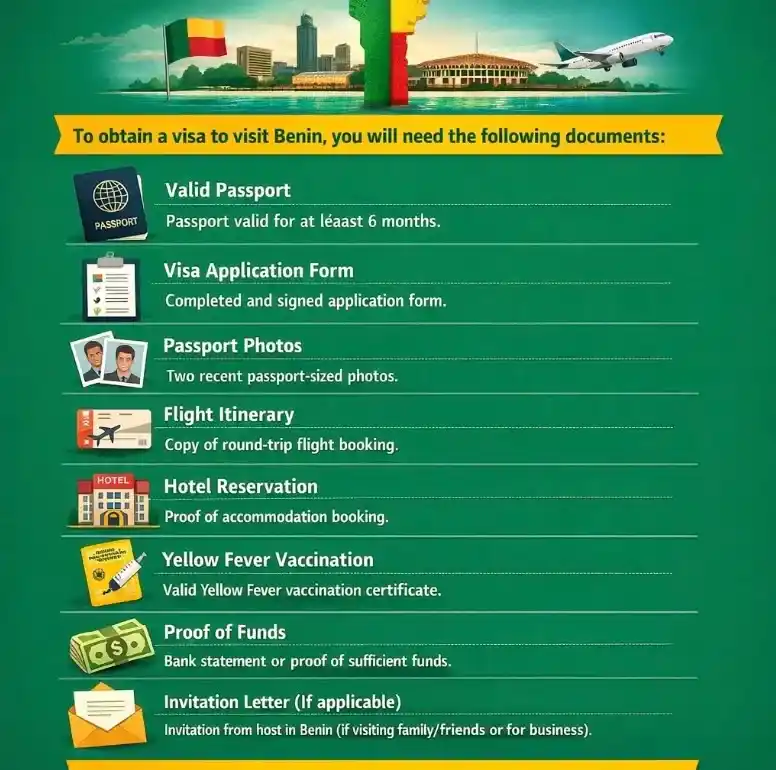
Passport preparation is mostly about accuracy, not volume. Benin's platform asks for the document number and expiry date at the start, so have the physical passport nearby while completing the form.
For travellers departing from Philippines, it is also worth checking that airline bookings use a name format that can be reconciled with the passport. Minor formatting differences are common, but the visa form itself should follow the travel document.
Dates and route
When the trip includes an overnight flight, check the local arrival date shown on the ticket. That is more useful than assuming the departure date from home is also the Benin entry date.
Single entry is for one arrival. Multiple entry matters when the itinerary deliberately takes you out of Benin and back again during the visa period.
Published visa choices
The figures above are the government fees published for self-service online applications. They do not include separate assistance or banking charges.
Application window
If departure is close, do not interpret '1–96 hours' as a guarantee. The official wording describes how long processing can take, while the seven-day recommendation is the safer planning advice.
Card payment
Before payment, make sure the card can complete 3-D Secure authentication. A card that works in shops is not automatically configured for every international online transaction.
After submission
After confirmed payment, Benin says the application number is sent by email. Keep that message; the number is the reference used to check status.
The best application is the one that disappears into the travel plan because every detail already agrees. If something does not match, fix it before payment rather than after issue.
Start with the passport nationality and any applicable exemption. If a visa is required, then compare the published eVisa duration and entry options against the itinerary.
Benin states that eVisa validity begins on the intended date of entry entered in the travel-data section.
The published self-service fees are €50 for 30-day single entry, €75 for 30-day multiple entry and €100 for 90-day multiple entry.
Keep the application number sent by email after confirmed payment because it is used for status tracking.
Check the passport, the first Benin arrival date and every planned re-entry. If those three facts are settled, the visa choice is much easier to judge.